

Table of Contents
- How to Choose an Electrolyte Powder Without Artificial Sweeteners
- A Verified Sweetener Audit: Ingredient-by-Ingredient
- Sugar-Free Electrolyte Powder Without Artificial Sweeteners: What That Label Actually Means
- Electrolyte Powder Without Stevia: Stevia-Free Options and Why They Matter
- Unsweetened Electrolyte Powder: Unflavored, No-Sweetener Formulas
- Electrolyte Powder for Athletes: Sodium, Potassium, and Magnesium Compared to Daily Needs
- Common Mistakes When Buying Electrolyte Powder Without Artificial Sweeteners
- Frequently Asked Questions
Last Updated: October 4, 2026
How to Choose an Electrolyte Powder Without Artificial Sweeteners
Finding the best electrolyte powder without artificial sweeteners starts with reading past the front of the package.
This guide covers what to look for, how to audit a label in under a minute, and where buyers get tripped up.
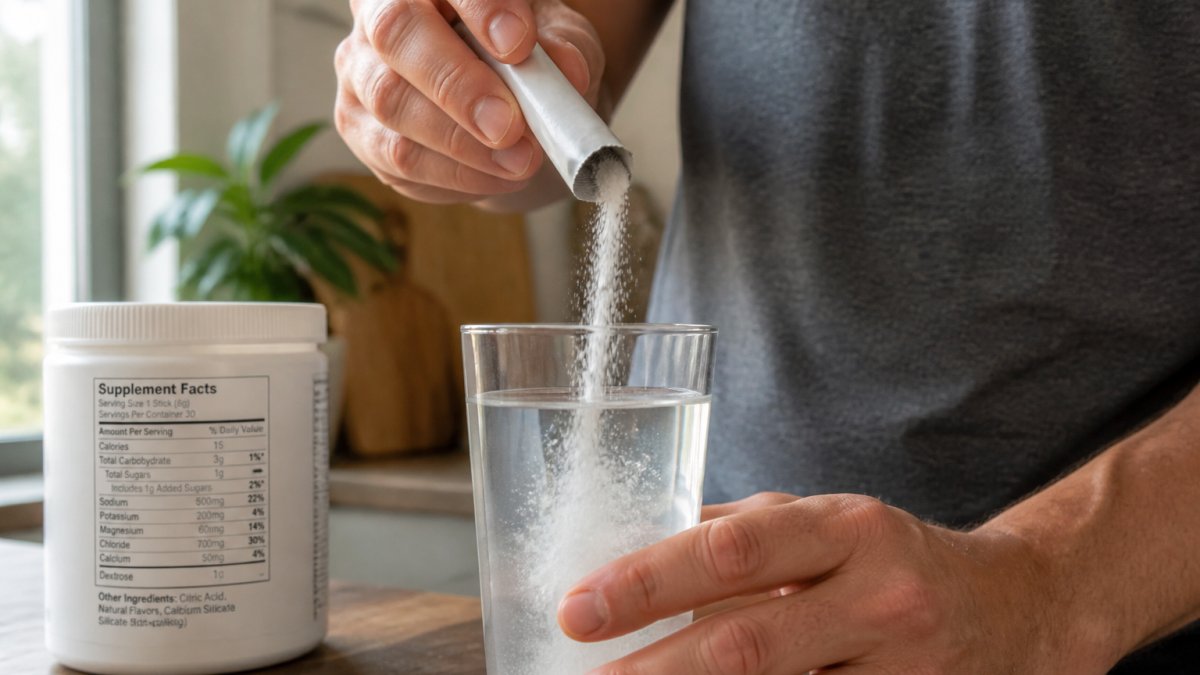
Artificial Sweeteners vs. All Non-Sugar Sweeteners: A Precise Definition
Artificial sweeteners are synthetic sugar substitutes created in a lab, while non-sugar sweeteners include both synthetic and plant-derived options. "No artificial sweeteners" does not mean "no sweetener at all."
Artificial sweeteners include sucralose, aspartame, saccharin, and acesulfame potassium. Non-sugar sweeteners cover a wider net: stevia, monk fruit, allulose, and sugar alcohols like erythritol.
A product can be free of artificial sweeteners and still contain stevia or erythritol, so screen for both categories if you want a truly unsweetened electrolyte powder.
What to Look For on the Label
Check the ingredient panel for three things: the sweetener source, the electrolyte mineral forms, and any fillers or anti-caking agents. The front of the package tells you nothing useful.
- Sweetener audit: Scan for sucralose, aspartame, acesulfame potassium, stevia, monk fruit, erythritol, and dextrose. Each has different implications for taste and digestion.
- Mineral forms: Look for chelated minerals or named sources like sea salt and Aquamin magnesium rather than vague "electrolyte blend" language.
- Serving size clarity: A label listing "sodium" without a milligram amount per serving is a red flag.
According to the FDA guidance on labeling of sweeteners, sweeteners must be declared by their common or usual name in the ingredient list, which makes a proper audit possible if you know what to look for.
A Verified Sweetener Audit: Ingredient-by-Ingredient
A verified audit means checking every sweetener on the panel against what it is, how it is regulated, and how your body handles it.
The key distinction: "no artificial sweeteners" is not the same claim as "no sugar," "no added sugar," or "no sweeteners." Each is regulated separately, and a product can satisfy one while failing the others.
| Sweetener | Type | Source | Regulatory category | Common use |
|---|---|---|---|---|
| Sucralose | Artificial | Synthetic | Non-nutritive sweetener | Zero-calorie mixes |
| Acesulfame potassium (Ace-K) | Artificial | Synthetic | Non-nutritive sweetener | Blended sweetener systems |
| Aspartame | Artificial | Synthetic | Non-nutritive sweetener | Flavored drink mixes |
| Saccharin | Artificial | Synthetic | Non-nutritive sweetener | Legacy diet products |
| Stevia (rebaudioside A) | Non-sugar, plant-derived | Leaf extract | Non-nutritive sweetener, not artificial | "Natural" powders |
| Monk fruit (mogroside) | Non-sugar, plant-derived | Fruit extract | Non-nutritive sweetener, not artificial | Premium mixes |
| Allulose | Non-sugar | Rare sugar | Non-nutritive sweetener, not artificial | Low-calorie powders |
| Erythritol | Non-sugar | Sugar alcohol | Non-nutritive sweetener, not artificial | Low-calorie powders |
| Dextrose | Sugar | Corn-derived | Nutritive sweetener / carbohydrate | Absorption support |
What the label has to tell you
Under FDA guidance on labeling of sweeteners, sweeteners must be declared by their common or usual name in the ingredient list, which makes a proper audit possible if you know what to look for. That means "natural flavors" is not a legal hiding place for sucralose, if sucralose is present, it must appear by name.
Three label checks separate the categories cleanly:
- "Sugar-free" means less than 0.5 grams of sugar per serving. It says nothing about which sweetener replaced the sugar. A sucralose-sweetened powder and an erythritol-sweetened powder can both carry this claim.
- "No added sugar" means no sugar or sugar-containing ingredient was added during processing. A product can still contain naturally occurring sugars from other ingredients.
- "No artificial sweeteners" is a marketing claim, not a regulated nutrient content claim. The FDA does not define "artificial" for this purpose, so the only reliable test is the ingredient panel itself.
Reading the panel in order of descending weight
Ingredients are listed in descending order by weight, your fastest signal:
- If a sweetener appears in the first three ingredients, it makes up a meaningful share of the scoop.
- If it appears last, the amount is likely minimal, often there for taste balance rather than sweetness.
- If a product lists "electrolyte blend" without breaking out sodium, potassium, and magnesium in milligrams per serving, treat the mineral content as unknown.
Dextrose is not a sweetener in this context
Dextrose appears on some panels as a carbohydrate source rather than a flavoring agent. In small amounts, it supports sodium absorption through the SGLT1 transport pathway in the gut, the same mechanism that makes glucose-containing oral rehydration solutions effective. Some formulas include it at under a gram per serving, but if your goal is a truly unsweetened powder, dextrose still counts against that goal.
The four categories, side by side
- No artificial sweeteners: may contain stevia, monk fruit, allulose, or sugar alcohols.
- No sugar: less than 0.5 g sugar per serving; may still contain non-nutritive sweeteners of any kind.
- No added sugar: no sugar added during processing; naturally occurring sugars may remain.
Sugar-Free Electrolyte Powder Without Artificial Sweeteners: What That Label Actually Means
A sugar-free electrolyte powder without artificial sweeteners contains no caloric sugar and no synthetic sweeteners, but may still include plant-based sweeteners or sugar alcohols.
Under FDA labeling regulations for sugar-free claims, a product can be called sugar-free if it contains less than 0.5 grams of sugar per serving.
A powder sweetened with erythritol and stevia is sugar-free and free of artificial sweeteners; a powder with no sweetener at all is a different category.
Electrolyte Powder Without Stevia: Stevia-Free Options and Why They Matter
An electrolyte powder without stevia avoids the plant-derived sweetener entirely, which matters for anyone who dislikes stevia's lingering aftertaste or experiences digestive discomfort from it.
Stevia's aftertaste is the most common complaint: it registers as bitter or licorice-like to many tasters, and that flavor intensifies when combined with sodium.
Stevia-free formulas typically fall into two groups: those sweetened with monk fruit or a sugar alcohol, and those with no sweetener at all.
Unsweetened Electrolyte Powder: Unflavored, No-Sweetener Formulas
Unsweetened electrolyte powder contains only electrolytes and a carrier or absorption aid, with no sweetener of any kind. These formulas taste like saltwater, nothing masks the mineral profile or adds sweetness you did not ask for.
Unflavored formulas work well for people who:
- Mix electrolytes into other drinks, smoothies, or protein shakes
- Want full control over flavor and sweetness
- React poorly to sweeteners of any kind, natural or synthetic
The trade-off is obvious: if you dislike the taste of salt in water, an unsweetened powder will not win you over. Mixability also matters more, since no flavoring agent helps the minerals dissolve evenly.
Electrolyte Powder for Athletes: Sodium, Potassium, and Magnesium Compared to Daily Needs
Electrolyte powder for athletes should be dosed against actual sweat loss, not a generic daily recommendation. Sodium is lost in the largest quantity through sweat, and most general hydration products underdose it for serious training. But "more sodium" is not automatically better, the right number depends on sweat duration, heat, and your physiology.
Daily needs versus training needs
These are different numbers, and conflating them is the most common dosing error:
- Sodium: General daily intake guidance for adults sits around 1,500 mg, though typical intake is higher. Sweat sodium concentration varies widely between individuals, a common range is roughly 500 to 1,500 mg of sodium per liter of sweat, and heavy sweaters in heat can lose well over 1,000 mg per hour of hard training.
- Potassium: Daily needs run around 3,400 mg for adult men and 2,600 mg for adult women. Sweat potassium loss is comparatively small, so potassium is rarely the limiting electrolyte during a session.
- Magnesium: Daily needs sit near 400 mg for adult men and around 310 to 320 mg for adult women. The form matters, chelated and marine-derived magnesium absorbs more efficiently than magnesium oxide.
Matching the formula to the use case
The right electrolyte profile changes with the scenario:
- Everyday hydration (low sweat): A light formula with modest sodium is usually enough. High-sodium products can taste overwhelming when you are not sweating heavily.
- Recreational exercise under an hour: Water plus a moderate-sodium mix covers most needs. Potassium and magnesium are supporting players here.
- Endurance training and events (2+ hours): Sodium replacement becomes the priority. This is where formulas dosed for real sweat loss separate themselves from general hydration products.
Why sodium gets the emphasis
For a 3-hour endurance event, replacing sodium is the priority: it drives fluid balance and helps maintain blood volume during prolonged effort. Potassium and magnesium support muscle function and recovery but are not the limiting factor during the session. A formula with 1,000 mg of sodium and modest potassium will outperform one with balanced-looking numbers but only 200 mg of sodium for a heavy sweater.
How to estimate your own needs
You do not need a lab test to get close. A practical approach:
- Weigh yourself before and after a training session of known duration, accounting for fluid consumed.
- Note the conditions, heat and humidity raise sweat rate substantially.
- Use the difference to estimate hourly fluid loss, then match sodium intake to roughly the middle of the common sweat-sodium range.
- Adjust based on how you feel and how your clothes and skin taste afterward.
Safety and when to seek medical advice
Electrolyte needs vary by individual, and more is not always better. Sodium restriction is a medical recommendation for some people, and kidney or heart conditions change how the body handles sodium and potassium. If you take diuretics, blood pressure medication, or any drug that alters electrolyte balance, talk to your doctor before using a high-sodium formula.
Cost per serving and value comparison
Cost per serving is the only price metric that matters when comparing electrolyte powders. A $40 tub with 40 servings costs a dollar per serving; a $25 box of 16 stick packs costs more per use.
Here is how to calculate it:
- Divide the total price by the number of servings in the container.
- Check whether a "serving" is one scoop or two. Some brands understate serving size to look cheaper.
- Factor in shipping if you order single-serve packets.
- Compare mineral content per serving, not just price. A cheap serving with 200 mg of sodium is not the same value as one with 1,000 mg.
Our Engineered Electrolytes runs $27.99 and delivers a full-spectrum mineral blend with under 1 gram of dextrose per serving, built around Himalayan pink salt, sea salt, and Aquamin magnesium, dosed for real sweat loss rather than label appeal.

Common Mistakes When Buying Electrolyte Powder Without Artificial Sweeteners
The most common mistake is trusting front-of-package claims without reading the ingredient panel. "Natural," "clean," and "no artificial sweeteners" are marketing terms with narrow legal definitions that rarely tell the full story.
Other frequent errors:
- Confusing "no artificial sweeteners" with "no sweeteners." A product can be free of synthetics and loaded with sugar alcohols.
- Ignoring the mineral forms. Magnesium oxide is cheap and poorly absorbed; chelated minerals cost more and work better.
- Chasing flavor over function. A great-tasting mix with minimal sodium will not hydrate you during a long event.
Picking the right formula comes down to matching mineral content to your actual sweat loss, not the loudest claim on the package. Dialed Hydration builds Engineered Electrolytes around a full-spectrum blend of Himalayan pink salt, sea salt, and Aquamin magnesium, with under 1 gram of dextrose per serving to support SGLT1 absorption and no fillers or mystery blends.
Frequently Asked Questions
Are there natural electrolyte powders that don't contain sweeteners?
Yes. Unsweetened electrolyte powder contains no sugar, no artificial sweeteners, and no natural non-sugar sweeteners like stevia or monk fruit. These formulas rely on sodium, potassium, magnesium, and sometimes a small amount of dextrose for absorption. They are ideal for people who want hydration without sweetness or aftertaste. Check the ingredient list for terms ending in -ol, -ose, or names like sucralose, acesulfame potassium, stevia, and monk fruit to confirm a product is truly unsweetened.
What is the safest and healthiest electrolyte powder?
The safest option is one with transparent labeling, no artificial sweeteners, and electrolytes dosed to match your sweat loss. Look for sodium, potassium, and magnesium in meaningful amounts, and avoid proprietary blends. A formula with a small amount of dextrose (under 1g) can support sodium absorption through SGLT1 without adding significant sugar. People with kidney conditions, heart conditions, or those taking blood pressure medication should talk to a healthcare provider before using any electrolyte powder.
What should I look for in an electrolyte powder without artificial sweeteners?
Check three things: the sweetener source (none, stevia, monk fruit, or sugar), the electrolyte amounts per serving (sodium, potassium, magnesium in milligrams), and the cost per serving. Also look for third-party testing or clear ingredient sourcing. Avoid products that hide amounts in proprietary blends. For athletes, sodium per serving is often the most important number, since sweat sodium losses vary widely. A transparent label lets you compare formulas accurately.
How much sodium should an electrolyte powder contain?
Sweat sodium concentration varies by person, typically ranging from about 400 to 1,800 milligrams per liter of sweat. A general starting point for athletes is 300 to 600 milligrams of sodium per serving, adjusted for heat, duration, and individual sweat rate. Endurance athletes in hot conditions may need 800 to 1,000 milligrams or more per hour. Check the label for sodium per serving and compare it to your estimated losses, not to a universal recommendation.